


“Then one Sunday morning, before winter break, Abby’s boyfriend, Whitney, materialized at their kitchen table, reading something called ‘Of Grammatology’. When Madeleine asked what the book was about, she was given to understand by Whitney that the idea of a book being ‘about’ something was exactly what this book was against, and that, if it was ‘about’ anything, then it was about the need to stop thinking of books as being about things.”
― Jeffrey Eugenides, The Marriage Plot
Has this ever happened to you?
You check your messages and see that a long-lost friend or acquaintance has reached out. They have an exciting new idea for a company, an app or a business and they just need a liiiiiittle bit of specialized, unpaid labor from you to get started. They can’t pay you (yet!) but their idea is a surefire success. They will owe you big time, and as soon as this thing takes off, they will be riding off into the sunset with untold riches and they promise to carve off a slice for you.
Sitting at your desk, working your full-time job, you shake your head and laugh to yourself. “Congrats on the idea!”
Talk is cheap
I’ve always been a bit bored by the idea of ideas. They’re quick and easy to come by. Of course, I don’t believe in stealing, plagiarism or ripping anyone off. But people spend a lot of time debating idea credit and origin when having a truly original idea is very, very rare and not especially valuable in and of itself.
I’m much more interested in execution. What was your process? What tools did you use? Given these constraints, how did you actually break down the problem and solve it? How many at-bats did it take? What did you try, what did you learn, how did you reframe? What did attempts 3, 4, 5, and 6 look like? It’s why I liked being part of the design systems community so much: it wasn’t competitive and no one was precious about ideas. We were all trying to build roughly the same thing, just in different places.
So I’m sort of dreading the next phase of this project, which Very Much Involves Talking About “The Idea.” And to be fair, I think of it more as “Several Small Ideas Woven Together Well.” It does feel like important context... what we’re working on and why we’re passionate about it (we are passionate about it!). Plus, talking about the idea will also set the stage for all of the stuff I’m actually excited to share, which is Way Less About “The Idea” and Way More About All of The Fun New Ways to Build.
So where is this dread coming from? Why do I feel so small when I talk about it? I know I haven’t nailed the marketing pitch yet, the zingy one liner that sums the whole thing up neatly and cleanly. And the more I work on it, the thornier and more complex everything feels. As I uncover more complexity, the elegant solution I’m envisioning gets further and further away in my mind. It’s not good yet! It has the potential to be good, but it’s not good yet.
More binaries
Over the past couple of months, when I’ve shared what we’re working on to friends and family, I usually get one of two reactions:
Wow! That’s amazing! I can’t believe nobody has thought of that before! That sounds so useful!
Oh. Cool! Good for you. Is that ... a thing?
Both of these reactions make me uncomfortable.
The first one makes me uncomfortable because “The Idea” is not a new category of product. We didn’t think we had discovered a new problem that nobody else had ever noticed. We just had a pain point in our own lives, found the available options lacking, and started imagining a version that would work better for us. We have a specific perspective about why it’s hard and we think there is room to try to make something better.
The second one makes me uncomfortable because I spent so many years designing for 150+ million users at a major tech company. At that scale, the goal is to appeal to as many people as possible. So when people don’t immediately get it, doubt creeps in. Is this really a meaningful problem? Is our solution too niche? Too complicated? Have I explained it badly? Am I totally off-base?
This binary I’ve created for myself makes the stakes of simply talking about “The Idea” artificially high. If I describe it with any confidence, its feels like I’m taking credit for the whole category, because awareness of that category is low. If someone’s reaction makes me feel doubt, then I’m undermining my belief in the indie path that got me excited to pursue this project in the first place.
The algorithm is not my friend
In reality, we’ve actually been working on this idea on and off since 2021. Just as a little hobby app for ourselves, because we weren’t satisfied with anything else on the market. Until recently, it wasn’t even possible to create an account because we were the only ones using it. But now that I’ve turned it into my full-time job, I have a lot more time to dedicate to it. And my algorithm has caught up with me.
Many, many times over the last few months, I’ve gotten excited about a feature I’m building, only to be served an ad for an existing app that does the exact same thing. On the one hand: yay! The market and demand in this space is bigger than I thought. On the other, bigger, louder, hand: Is there still room for us in that space? If there are already so many players here, what’s the point?
In general, my mindset is constantly ping-ponging between “we can differentiate with better design!” and “badly designed products win all the time.”
Mindset practice
Mindset-wise, a few things are rising to the top for me this week:
Ideas are fine, but truly great execution is still hard and still takes time
The first version is just the first version
Similar things can coexist. Not everything needs to be for everyone
There is no single definition of “winning” a category or being the “best” product
It’s okay to be new at things, or out of practice at old things
Good design doesn’t speak for itself
That last one gives me deja vu. As a junior designer, I treated stakeholder questions as evidence that the design wasn’t good enough yet. I assumed there was a single “right” solution that, if uncovered, would sell itself to the project approver. Eventually, I learned that packaging the work was a crucial part of the job: that I needed to position my recommendations against the problem and tradeoffs with a compelling narrative to push it forward.
Somehow, now that I’m working on my own thing, I entirely forgot that lesson.
Lunch
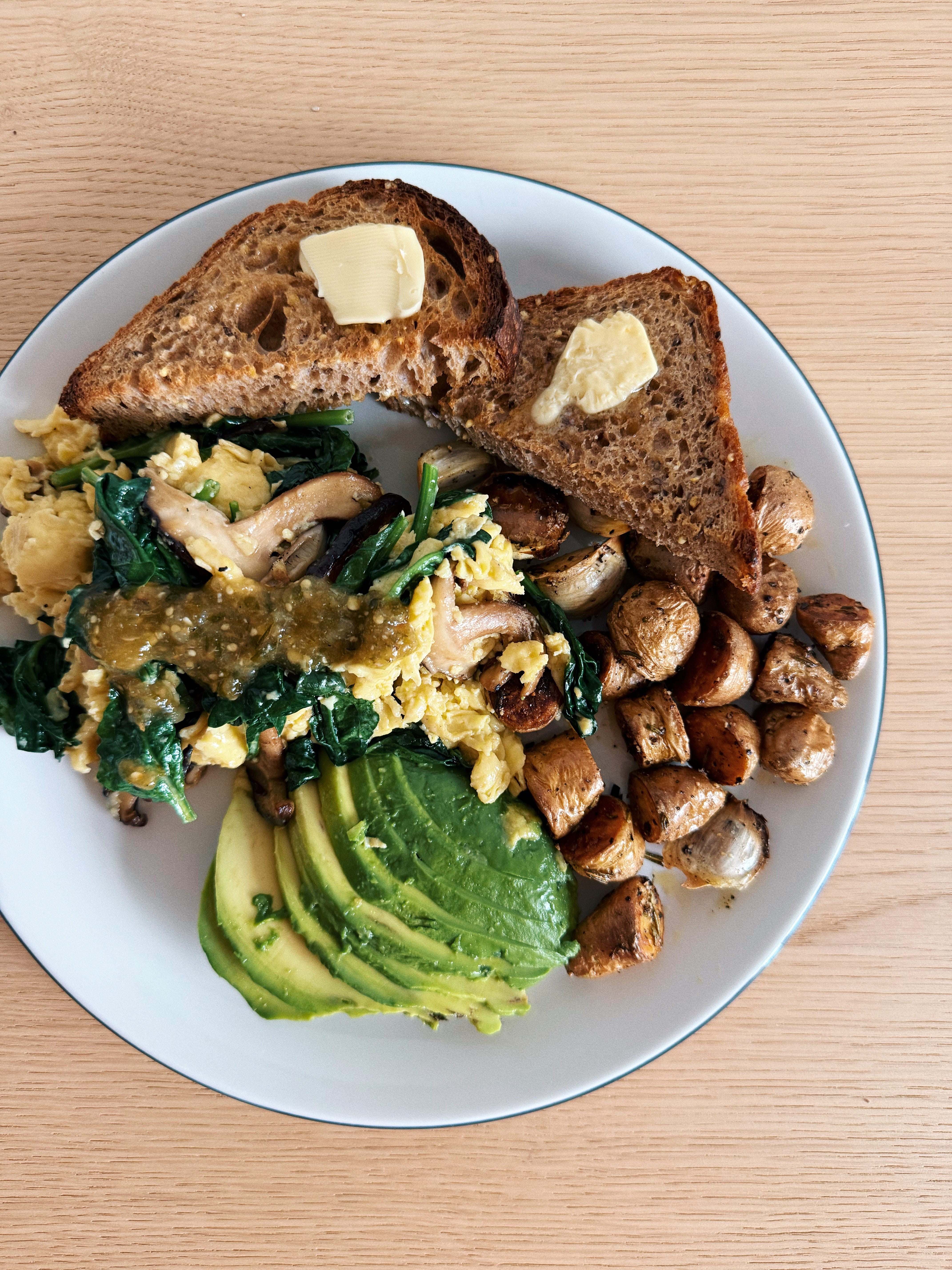
This week for lunch, I tried to recreate my favorite brunch from Zazie in San Francisco: a mushroom / spinach scramble with toast, roasted potatoes, avocado and habanero hot sauce.
See you next week!